
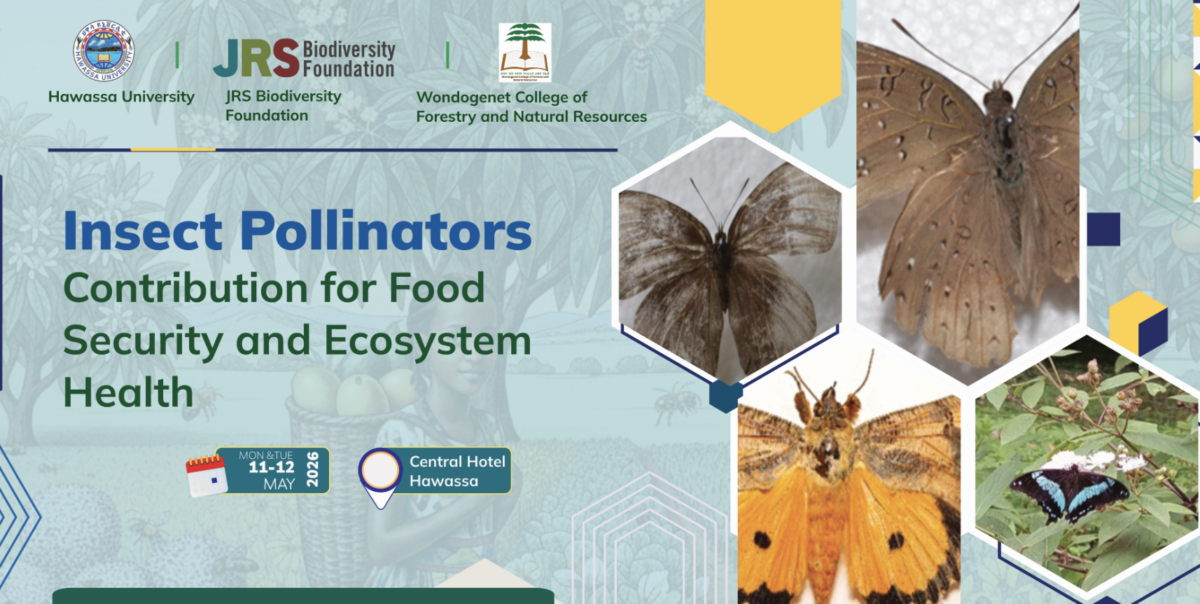
Hawassa University’s Wondogenet College of Forestry and Natural Resources (WGCFNR), in partnership with JRS Biodiversity Foundation, is working to highlight the often overlooked importance of insect pollinators Through a combination of field research, scientific publication, and multi-stakeholder engagement, the university is building the knowledge base and coalitions needed to protect Ethiopia’s irreplaceable pollinator communities.
Project Director Dr. Zerihun Firma shares three interconnected developments from that effort. First, the convening of a national workshop that united researchers, policy makers, and conservation experts around the urgent need for evidence-based pollinator policy. Second, the publication of a landmark field guide documenting insect pollinators across Bale Mountains National Park — one of Africa’s most biodiverse protected areas. Third, the release of a companion identification guide for Kafa Biosphere Reserve, home to wild Coffea arabica and a living archive of Ethiopia’s forest heritage.
HU Hosts Multi-Stakeholder Workshop on Insect Pollinators and Food Security
Wondogenet College of Forestry and Natural Resources (WGCFNR), in partnership with JRS Biodiversity Foundation, convened a two-day national workshop on May 11–12, 2026, bringing together academics, researchers, policy makers, and environmental experts to address the pivotal role of insect pollinators in food security and ecosystem health.
Dr. Teshale Woldeamanuel, Dean of WGCFNR, urged all participants to contribute to a forthcoming policy brief grounded in research evidence. He described insect pollinators as “the invisible engineers behind biodiversity and environmental protection.” Prof. Fantaw Yimer, Director of Research Affairs at Hawassa University, pledged the university’s continued support for research partnerships of national and global importance.
Keynote addresses were delivered by Dr. Firdu Azerefegn (Hawassa University) and Prof. Emana Getu (Addis Ababa University). Dr. Firdu highlighted that insects ensure the pollination of more than 80% of the world’s flowering plants, while Prof. Getu challenged the popular misconception that insects are abundant, arguing instead that many pollinator species are endangered. Project PI Dr. Zerihun Girma and his team also presented field research findings from Kafa Biosphere Reserve and Bale Mountains National Park.
Source: Hawassa University Press Release | May 14, 2026

New Field Guide Documents Insect Pollinators of Bale Mountains National Park
A comprehensive field guide titled “Insect Pollinators of the Bale Mountains National Park: An Essential Field Guide” was published in April 2026 by a research team from WGCFNR and JRS Biodiversity Foundation. The guide was prepared by Dr. Zerihun Girma, Dr. Araya Gebresilassie, Dr. Kidist Fekadu, Dr. Mikias Biazin, and M.Sc. Manaye Misganaw.
Bale Mountains National Park (BMNP), established in 1970 in the Oromia Regional State of southeastern Ethiopia, spans approximately 2,200 sq km and is globally significant for its high rate of endemism. Its elevational range — from 1,500 m in the Harenna Forest to 4,377 m at the summit of Tullu Dimtu — supports extraordinarily diverse pollinator communities. The park is also the last stronghold of the endangered Ethiopian Wolf (Canis simensis).
The guide covers major pollinator groups including Lepidoptera (butterflies and moths), bees, and other insect orders, providing identification keys, ecological notes, and conservation status for species documented across the park’s distinct ecological zones. It also details the principal threats to pollinator survival, including habitat fragmentation, monoculture farming, excessive pesticide use, climate change, disease spillover, and invasive species.
Source: Field Guide — BMNP, Hawassa University / JRS Biodiversity Foundation | April 2026

Insect Pollinator Identification Guide Released for Kafa Biosphere Reserve
In a companion publication also released in April 2026, the same research team produced an “Insect Pollinators Identification Guide for Kafa Biosphere Reserve” (KBR). Kafa, one of Africa’s most important biosphere reserves, is renowned as a global center of origin of wild Coffea arabica and hosts extraordinary forest biodiversity.
The KBR guide documents insect pollinator diversity across the reserve’s core, buffer, and transition zones, with emphasis on species involved in pollinating both wild plant communities and key agricultural crops such as coffee. The guide notes that over 75% of leading global food crops benefit from animal pollination, with insect pollinators contributing to roughly 35% of global food volume by weight — services valued at between US$235 billion and US$577 billion annually worldwide.
Both field guides are intended as practical references for researchers, park managers, educators, and conservation practitioners working in Ethiopia’s critical highland ecosystems. They represent the first systematic documentation of insect pollinator communities in these two protected areas and constitute a foundational resource for future monitoring and conservation planning.
Source: Field Guide — KBR, Hawassa University / JRS Biodiversity Foundation | April 2026
Read more about the Hawassa University’s JRS project Insect Pollinator Diversity under Different Land Uses in and around Kafa Biosphere Reserve and Bale Mountains National Park here.