
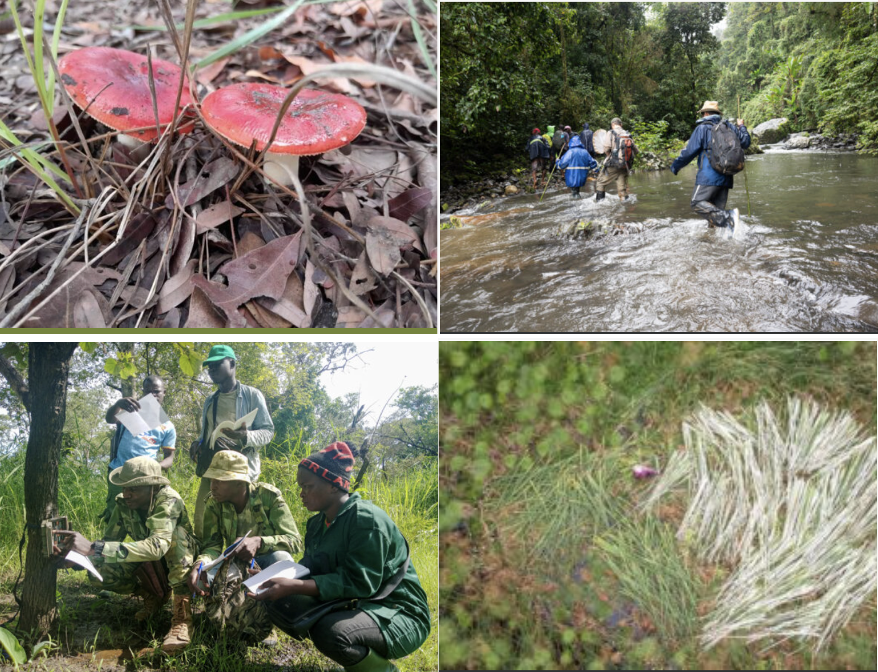
JRS recently began implementation of five new grants across sub-Saharan Africa, spanning biodiversity monitoring, bioinformatics, and agrobiodiversity. These grants will build on and complement existing community knowledge, creating repositories of biodiversity data and research skills for local stakeholders.
The African Wildlife Foundation (AWF) is set to receive $200,000 over 18 months to strengthen biodiversity monitoring and data sharing in two high-priority landscapes — the Gola Rainforest National Park in Sierra Leone and the Kilombero Valley in Tanzania. The project will train 50 conservationists in methods such as mist-netting, acoustic monitoring, and camera trapping, and aims to generate standardized, shareable data to inform national biodiversity strategies, with plans to later expand activities to additional landscapes.
Re:Wild was awarded $150,000 over 24 months to build African capacity for lost species data collection and bioinformatics use in remote ecosystems of the Democratic Republic of Congo and Tanzania. Building on a successful 2024 JRS partnership, Re:Wild will support seven subgrants to engage local expert teams in applied field research, helping fill major taxonomic gaps in the bioinformatics record and connecting universities, museums, and conservation organizations in a regional network of researchers.
Pwani University will receive $115,717 over 24 months to conserve soil biodiversity in agroecosystems within a UNESCO Biosphere Reserve encompassing sacred forests of coastal Kenya. Led in partnership with the National Museums of Kenya and the University of Nairobi, the project will train four Master’s students, engage over 150 farmers in research activities, and work with 17 policy stakeholders to document soil biodiversity indicators and integrate indigenous knowledge into conservation and development policy.
Musekese Conservation was awarded $129,388 over the next 24 months to assess the biodiversity impact of varying land-use and farming practices in Zambia’s Greater Kafue Ecosystem. Working with partners including the Zambia Department of National Parks and Wildlife and The Nature Conservancy, the project will build a scalable, multi-taxa monitoring framework using remote sensing, camera traps, and acoustic sensors, while also building capacity among women leaders and farmers practicing regenerative agriculture.
Finally, Conserve Global will receive $117,147 over 24 months to document and conserve agrobiodiversity in southern Mozambique’s Mwai Community Concession Area — a region undergoing rapid ecological and socio-economic change. In partnership with local community organizations and Universidade Eduardo Mondlane, the project will conduct comprehensive biodiversity surveys, co-create management plans with local communities, and build local capacity for participatory monitoring to support food security and sustainable resource management.
Read more about JRS funded projects here.