
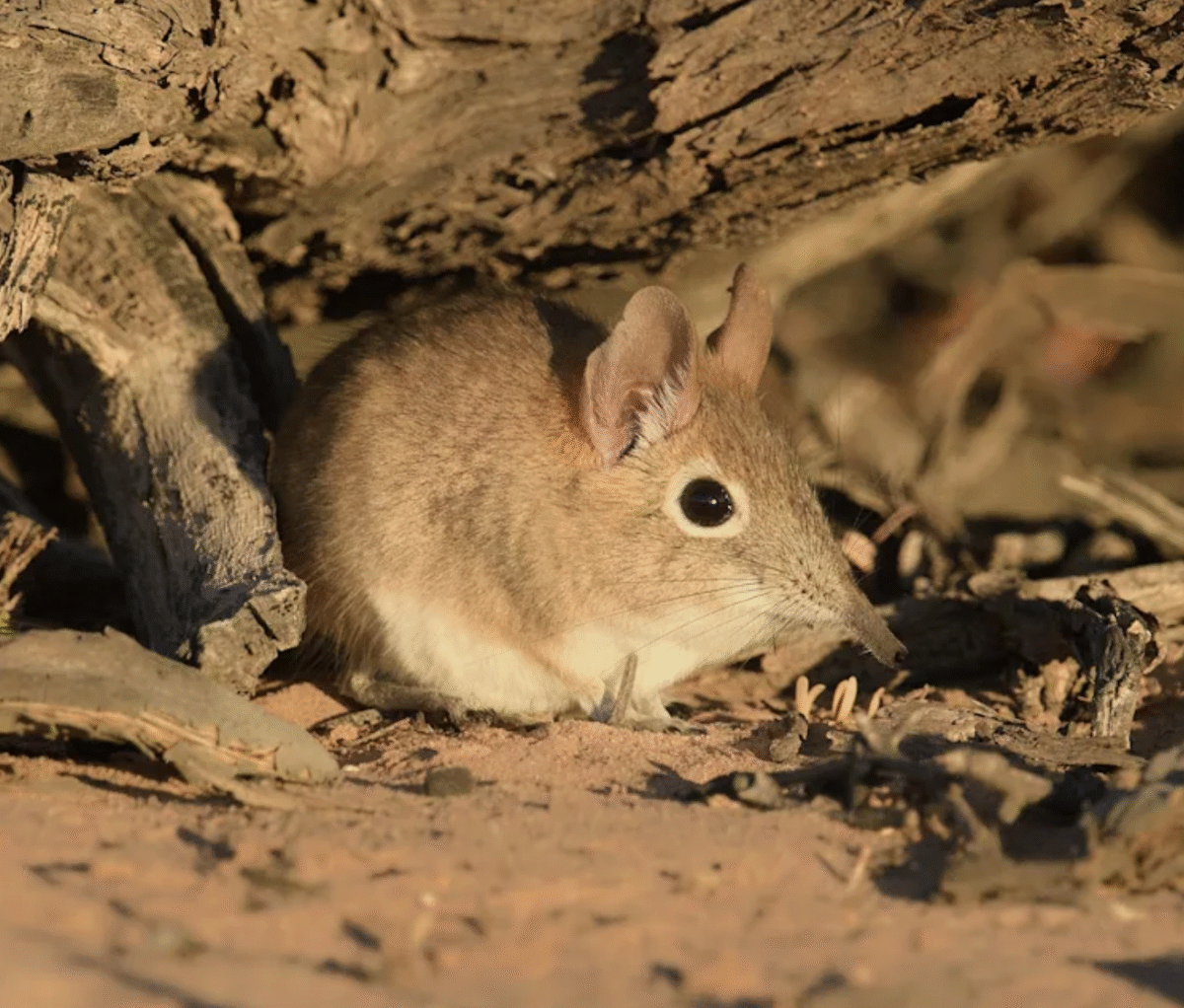
Drs. Zoe Jewell and Sky Alibhai co-founded WildTrack in 2011 to address a widespread need for less invasive and more cost-effective tools to monitor endangered species. In 2025 they completed the 18-month JRS sponsored project Novel Biodiversity Metric: Small Mammal Track Analysis using AI, Morphometrics and Traditional and Local Ecological Knowledge (TaLEK) in collaboration with the Tswalu Foundation and Oppenheimer Generations Research and Conservation, We are please to share the following project summary from Zoë Jewell & Sky Alibhai.
———————————————————–
When we think about biodiversity monitoring, we typically picture camera traps, satellite images, or scientists live‑trapping and fitting collars or tags to animals in the field. But what if some of the most powerful clues to ecosystem health are already lying quietly on the ground, written in dust and charcoal by tiny feet?
Our team set out to test exactly this idea. Our JRS‑funded project, “Delivering a proof of concept for a novel biodiversity metric: Small mammal track analysis using AI, morphometrics and Traditional and Local Ecological Knowledge (TaLEK),” set an ambitious goal: to turn the footprints of small mammals into a fast, affordable, non‑invasive biodiversity metric that local communities can use and own.
Over 18 months we built and tested this new approach in South Africa – and the results have been better than we dared hope!
Why small mammals, and why footprints?
Small mammals – which in South Africa include mice, rats, gerbils, sengis and shrews – are the ecological engine of the majority of ecosystems globally. They aerate soil, disperse seeds, consume insects and plants, and serve as prey for predators from owls to small carnivores. Because they respond rapidly to habitat change, they can be powerful indicators of ecosystem health. Yet they are notoriously hard to monitor: mostly invisible in natural habitat, too small for most camera traps, difficult to catch, and demanding expert identification.
Our resident expert small mammalogists and project co-PI’s, Dr Nico Avenant and Dr Marietjie Oosthuizen, told us right from the outset that current reliance on live‑trapping, handling, and expert identification to study small mammals can be stressful for animals, expensive, and logistically demanding, especially in remote or under‑resourced regions.
Our project therefore posed a simple question: could we get the same – or better – information from their footprints instead? If we could, this could transform our ability to monitor ecosystem health through the lens of these tiny mammals.
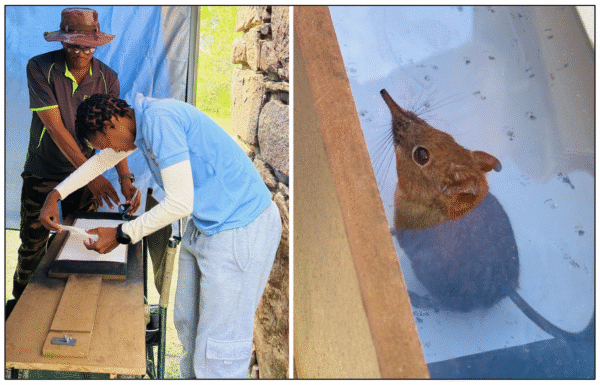
The method we developed is deceptively simple. Animals are encouraged to walk through a trackbox or tunnel where they step on charcoal and then onto white paper, leaving clear prints behind. Those prints are scanned or photographed and analysed using a combination of morphometric measurements and machine‑learning models. Crucially, this approach is designed to be non‑invasive and accessible, so that local trackers, students, and community partners can use it with minimal equipment.

A world first: AI that identifies “invisible” small mammal species with >90% accuracy
On the technical side, the project’s core achievement is a genuine world first. Using track data collected over 6 field sites, we trained machine‑learning models that can identify more than 25 small mammal species across five major groups – mice, rats, gerbils, true shrews and sengis – from their footprints alone, with over 90% accuracy.
This is remarkable for two reasons:
- Many of these species are visually indistinguishable, even to experts handling live animals in the hand. Yet the models could tell them apart from tracks that look almost identical to the human eye.
- The AI results are backed up by established morphometric models built in earlier work, giving us strong confidence that the machine‑learning system is not just accurate, but interpretable and scientifically robust, delivering a completely new class of biodiversity metric – one that effectively turns tiny footprints into a high-resolution snapshot of ecosystem integrity.
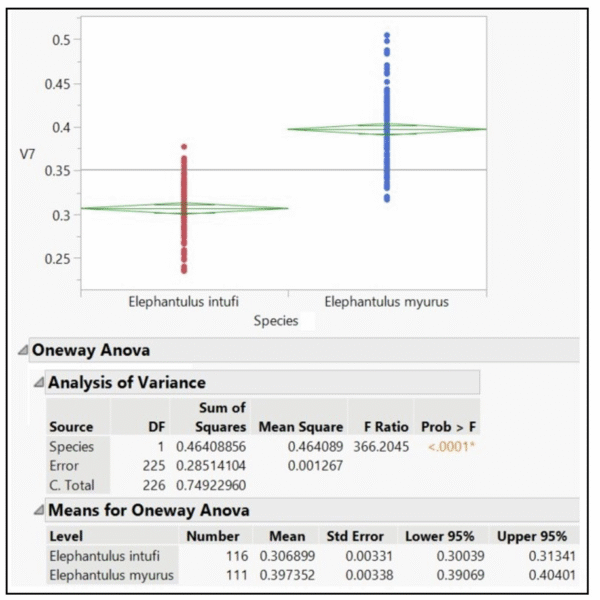

We have just published the first paper from this study demonstrating the use of morphometric identification for two visually indistinguishable sengi species, and the second, in progress, on the translation of traditional/local ecological knowledge and morphometrics into AI models for small mammals.
Revisiting range maps
Understanding where species roam is key to conservation. Traditionally, species range maps are compiled using data from where animals are seen, or trapped.
An unexpected bonus from this project was that using track data we were able to indicate discrepancies in current species range maps and expand range knowledge using footprint data. This approach could have a transformative impact on global species range mapping.

Listening to Traditional and Local Knowledge (TaLEK) at the heart of the work
Technology alone cannot safeguard biodiversity. From the outset, JRS challenged us to make sure this project did not become a “fly‑in, fly‑out” technical exercise, but instead built lasting capacity in the hands of local communities and scientists. That challenge became one of the most rewarding aspects of the work.

At each of our four field sites, we partnered with indigenous and local trackers, students, and scientists to co‑develop the methods, interpret the results, and explore how this tool could serve their own conservation priorities. Trackers guided us to the best places to find small mammals and shared their deep understanding of behaviour, habitat use, and environmental signs – the kind of Traditional and Local Ecological Knowledge (TaLEK) that rarely appears in field guides but is essential for successful fieldwork.
We also learned something humbling: most expert trackers rarely rely on tiny footprints in natural substrates when reading small mammal activity, because such tracks are often faint or absent. Instead, they use other signs such as burrows, runs, droppings and feeding marks. That meant interpreting tracks on our carefully prepared trackplates was outside many trackers’ experience. Rather than seeing this as a setback, we turned it into an opportunity.
With JRS’s support, we began building a bridge between traditional tracking skills and our new technology:
- We engaged a tracker‑artist‑scientist, David Wege, whose detailed interpretations and illustrations of small mammal tracks are forming the basis of a dichotomous key and a future field guide for South African small mammal footprints.
- We opened discussions with the Tracker Academy in South Africa, whose students already learn about small mammal signs but not species‑level footprints. In Phase 2, we hope to embed footprint identification into tracking school curricula and develop a way to certify these skills, creating new livelihood opportunities in conservation monitoring.
- We trained trackers at sites like Tussen die Riviere Nature Reserve, where staff are now eager to pass on what they’ve learned to local school groups and communities.

Fieldwork in a changing climate
Fieldwork is never predictable, and climate change added an extra layer of challenge. Across our four main South African field sites – with supplementary data from two others – we collected tracks from 25 small mammal species, but originally hoped for closer to 35. Several key indicator species, especially climbing mice in certain grasslands, were unexpectedly scarce.
Rather than chalk this up as “missing data,” we treated it as an ecological signal. Working with our South African colleagues, we have now assigned a student to collate long‑term climate data from one of the principal sites to understand how drought, rainfall patterns, and extreme events may be reshaping small mammal communities. At Tswalu Kalahari Reserve, for example, years of drought had depressed small mammal numbers; yet as good rains returned, our team recently recorded trap success above 40%, with previously absent species returning – a vivid glimpse of ecological succession in real time.
The project also faced more immediate practical challenges. Baboons repeatedly raided our trap sites, undeterred even by rubber snakes placed as decoys. Postal delays and unexpected materials problems forced us to repaint trackboxes when supposedly “white” sticky paper turned out transparent. Each obstacle pushed us to refine our methods – and one of our next objectives is to accelerate a key innovation: shifting from capture‑based SMaRT boxes to fully no‑capture SMaRT tunnels, where animals simply run through and leave their footprints behind.
These experiences underscored why non‑invasive, low‑cost tools are so vital in a rapidly changing climate. If we want to monitor sensitive ecosystems like the Kalahari at the pace that climate change demands, we need methods that are fast, gentle on wildlife, and resilient to the realities of field conditions
Community-Powered Conservation
One of the most inspiring outcomes of this JRS‑funded project has been the great diversity of people and skillsets that have contributed to, and been inspired by, the technology. Capacity building was not an add‑on to this project; it was the backbone.
Through fieldwork, workshops, and training sessions, we have engaged:
- Senior conservation scientists at organisations such as Oppenheimer Generations Research and Conservation (OGRC), who not only hosted fieldwork and conferences but also invited us to explore new projects on elephant corridor use and rare rain frogs.
- Museum field assistants, national park trackers, and guides across South Africa, who now see potential to use footprint technology in their own work and to teach it to local communities and school groups.
- Academic partners in Botswana and South Africa, including PhD students Major Tinao Petso and Captain Wazha Mmereki at BIUST, who have built related machine‑learning tools for ungulate and human footprints, with support from the Botswana Defence Force.
- Masters and PhD students in South Africa working on small mammal acoustics, who now use footprint identification to match species to the calls they record.
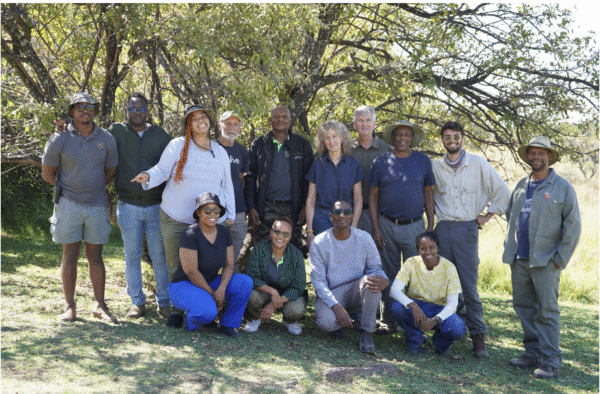
- University teams in Johannesburg and beyond, exploring applications such as distinguishing spotted from brown hyenas, and researchers like Prof. Louis du Preez, who plans to use the system for rain frog monitoring.
- Conservation biology Masters students and high‑school students, many of whom are encountering non‑invasive wildlife monitoring tools for the first time.
We have been especially encouraged by the enthusiasm from people at all stages of their careers – from seasoned trackers to aspiring researchers – who see in this technology a practical, empowering way to contribute to biodiversity monitoring. In many cases, participants have already started plotting their own projects and adaptations.
Data, tools, and an app for the future
Thanks to JRS’s support, Phase 1 has produced not just proof‑of‑concept results, but a suite of concrete tools and data resources that will underpin future work:
- A curated database of small mammal captures and species identifications across multiple South African sites.
- A growing library of trackplate images representing 25 species, which feeds both morphometric and AI models.
- A machine‑learning pipeline hosted on Amazon Web Services, now being upgraded with an inference feature that will eventually allow users to receive near‑real‑time species identifications from uploaded track images.
- The WildTrackAI app V2, already freely available on Android and iOS for data collection, with plans to integrate automatic footprint identification as the models mature.
- Morphometrics tools accessible via JMP software, which is freely available to academic institutions and students, making it feasible for universities in less‑resourced settings to adopt the approach.
We are committed to making these outputs as open and accessible as possible. Most datasets will be shared alongside peer‑reviewed publications, and the broader pipeline is being designed with sustainability in mind: models can be developed offline on local laptops, then deployed to the cloud for wider use, minimising ongoing cost
From proof of concept to conservation impact: the next phase
This JRS‑funded phase was explicitly designed as a proof of concept: could we develop a reliable, non‑invasive tool for small mammal monitoring, and could we anchor it in local capacity and TaLEK?
Looking ahead, we see several critical frontiers where the next phase can turn this technical success into direct conservation impact:
- From species lists to ecosystem diagnostics
We aim to use these footprint‑based methods to compare species richness and community structure against traditional trapping at a range of sites. If we can show that footprints capture the full complement of species more quickly, more cheaply, and more humanely, this could transform how small mammal monitoring is done – and by extension, how we assess ecological integrity in sensitive ecosystems like the Kalahari. - Scaling across Southern Africa
We plan to introduce the technology into at least one regional country with different habitats, working with a widening circle of universities, protected areas, and community groups. - Deepening partnerships with trackers and training institutions
Through the Oppenheimer Generations Research and Conservation organization in South Africa, we hope to formalise collaboration with the Tracker Academy and EcoTraining, incorporating footprint identification into their training and exploring ways to certify these skills for conservation employment. We also intend to support trackers and guides in using the technology as an educational tool for ecotourism and community outreach. - Integration into broader monitoring frameworks
We see strong potential to link footprint data with other technologies – such as drones, remote sensing, and acoustic monitoring – to create multi‑layered biodiversity assessments. In contexts like renewable energy development, this can offer before‑during‑after insights into wildlife impacts, helping keep “renewable energy on track for the future” without sacrificing biodiversity.
…and with special thanks to our partners in this project, JRS Biodiversity.
Over decades of fieldwork, we have collaborated with many funders and conservation partners and working with JRS has been up there amongst our best experiences.
From the very beginning, JRS helped us frame and sharpen our ideas, encouraging us to split an ambitious, multi-year plan into a focused proof‑of‑concept phase followed by a rollout phase, so that both technical innovation and community engagement could be properly tested and demonstrated. Throughout the project, communication has been clear, collaborative, and constructive, yet always allowed the flexibility to adapt to field circumstances.
Most importantly, they have shared our vision that puts non‑invasive technology and local expertise at the heart of biodiversity monitoring, one tiny footprint at a time!